 Midday
One Pouch, Two or Three Hours, and the Question of Which Hours
Focus & Recall is a 25-milliliter gel pack from HealthyCell with 40 milligrams of caffeine. I read the seller's own clock, the studies behind each line, and all 602 buyer reviews for the hours people chose.

This is a paid advertisement. Sponsored by Life Science Institute LLC (HealthyCell).
Gilbert Nash is the pen name of this desk.
Everything on this page about the pouch comes from the seller's own product page, its published label panel, its policies and its public review system, all read on September 21, 2026.
The customers quoted on this page are real, and their words are public on the seller's own page.
The small pictures beside them are illustrations, not the reviewers.
I call the hour after lunch my second morning.
The first morning is the one everybody talks about, with the coffee, the paper and the list.
The second one starts somewhere around one o'clock, after the plate is cleared.
It is the stretch where the invoice still needs checking, the drive to my daughter's still needs driving, and the page I am writing still needs finishing.
For most of my working life that stretch took care of itself.
These days it asks a little more of me, and I suspect it asks a little more of you.
That is why a small white pouch caught my attention this month.
It is sold for exactly that kind of stretch, and its seller is unusually specific about the clock.
Thirty minutes to start, two or three hours to last, and a box of thirty to spend them from.
When a product tells you how long it lasts, it hands you a budget.
And a budget is only as useful as the choices you make with it.
So I did three things.
I read the seller's own page for every sentence about time, and I sorted the thirteen lines of its label by the clock their own studies ran on.
Then I read all 602 reviews on the seller's page, one by one, and wrote down every hour a buyer mentioned.
That last job took an evening, and it turned out to be the most useful part of the whole exercise.
Fewer than one review in ten names an hour at all, and the ones that do split almost exactly between breakfast and the hour after lunch.
Five buyers also wrote that a late pouch cost them their evening, which is a detail worth more than any five-star rating.
What follows is long, because the clock turns out to be the most honest way to read this product.
It is also the most practical, because a man can decide about his own afternoons in a way he cannot decide about a clinical trial.
The Clock the Seller Prints on Its Own Page
Most supplement pages talk about what a product does.
This one also talks about when, in its own questions-and-answers section.
The first answer is about onset.
The seller writes that within thirty minutes of taking the product, you should feel a boost that lasts for a few hours, and it puts "2-3" in brackets to be exact.
The second answer is about rhythm.
Asked whether you can take it daily, the seller says yes, and adds that it is designed for long-term use.
The third answer is about the caffeine.
The seller gives the amount as 40 milligrams and describes it as about the same as a cup of coffee.
Onset, duration, rhythm, dose. That is a clock, printed by the people who sell the pouch.
I want to take those four statements seriously, because they are the seller's own terms.
And I want to test each one against something outside the seller's page.
The onset and the duration are claims about hours.
They can be checked against studies that measured people in the first hour or two after a single dose.
The rhythm is a claim about months.
It can be checked against studies that gave people something every day for weeks or years.
The caffeine comparison is a claim about a cup of coffee.
It can be checked against the federal government's own figures for what a cup actually holds.
Here is the short version of what I found, before the long one.
The hours claim has the better support, the months claim has the weaker support, and the coffee comparison is off by a wide margin.
None of that makes the pouch a bad buy.
It changes how you would use one, which is the whole point of reading the clock.

Six Hundred and Two Reviews, Read for the Hour
The seller's page carries 602 customer reviews as of this month, with an average of 4.6 stars.
Most of them carry the seller's mark of a confirmed purchase.
I did not read them for praise.
Praise is cheap in any review system, and four hundred and seventy-six five-star ratings tell you mostly that people who liked it bothered to say so.
I read them for time.
Every review that named an hour, a meal or a part of the day went into a notebook with its date and its stars.
Here is how the notebook came out, counted by hand.
The review system puts all 602 on one public page, and anyone patient enough can check my tally.
- About two dozen buyers say they take it in the morning, with breakfast, first thing, or before work.
- About two dozen say they take it in the afternoon, after lunch, or at a named hour such as two or three o'clock.
- A handful take it at night because they work nights or study at night.
- Five wrote that taking it late interfered with their night, and three of those five moved it to the morning.
- More than five hundred never say when they take it at all.
The last line is the one that matters most.
Fewer than one review in ten tells you anything about timing, which is the single thing the seller's own page is most specific about.
That is not the buyers' fault.
Most people write a review the way they sign a card, quickly and kindly, and move on.
But it means the 4.6 average cannot tell you which hour to pick.
Only the few dozen people who wrote the hour down can do that, and they are worth reading closely.
One more thing the notebook showed, which I did not expect.
The most common subject in these reviews is not focus, and not recall.
It is taste. More than one review in six mentions the flavor, for better or worse.
I will come back to the taste, because it decides whether you finish a box.
First, the two big clusters, morning and afternoon, because they tell you most about how people actually spend their pouches.

The First Morning: The Pouch With Breakfast
The morning group is the easier one to understand.
These are people who use the pouch the way most of us use the first cup of coffee.
Some take it first thing, before anything else.
Some take it with breakfast, and several stir it into a shake or a glass of juice.
One buyer wrote that her husband grabs one after breakfast and squeezes it on his way to the car.
Another wrote that she takes it when she gets into the office.
A few in this group describe it as a replacement for part of their coffee.
One wrote that she had gone from three cups a day to one, or none.
That last kind of review deserves a second look, and a number.
If the pouch is standing in for coffee, you want to know how much coffee it is standing in for.
The morning group also contains the most useful single sentence in all 602 reviews, and it came from a three-star rating.

HI; i hesitate to rate higher as I have only used the product for about a week. At first I thought it was interfering with my sleep so I make sure to take it first thing in the morning and haven't had a problem since. I mix it with juice and it tastes just fine. I'd need more time to assess fully.
A week of use, a problem noticed, the hour changed, the problem gone, and a refusal to judge the rest too early.
That is how I would want anybody to report on anything.
The morning pouch has one real advantage.
Whatever caffeine it carries has the whole day to clear before bedtime.
It also has one real limitation, and it is the reason this page exists.
If the stretch of your day that needs help is the one after lunch, a pouch at seven in the morning has done its two or three hours by ten.
A morning pouch covers the first morning. It does not reach the second.

Forty Milligrams, and How Much Coffee That Really Is
The seller's page describes 40 milligrams of caffeine as about the same as a cup of coffee.
The federal government puts a cup somewhere else.
The US Food and Drug Administration gives the caffeine in a 12-ounce cup of brewed coffee as somewhere between 113 and 247 milligrams. [1]
That is the size of cup most of us actually pour at home, and it is roughly three to six times what one pouch carries.
Even an 8-ounce cup, the small one, would carry about two-thirds of those amounts.
So 40 milligrams is closer to a third of a small cup than to a whole one.
There is a likely reason for the mismatch, and it is in the reviews rather than on the label.
Before 2022 the pouch carried much more caffeine, and I will show you the review that proves it a little further down.
The sentence about a cup of coffee may simply be older than the current recipe.
Either way, the label panel is the document that counts, and the label says 40.
Forty milligrams is a modest amount, and for many readers that is good news rather than bad.
It is well under the daily 400 milligrams the FDA cites as not generally associated with negative effects in most healthy adults. [1]
It is also well under the single dose of 200 milligrams that Europe's food-safety authority found raised no safety concerns for healthy adults. [2]
That same authority states that caffeine in moderate doses increases alertness and reduces sleepiness.
Those two facts together describe the pouch's most reliable line.
Caffeine does what it does, it does it in the hour you take it, and 40 milligrams of it is a small amount.
If you already drink two large mugs before noon, the pouch adds little to your day's total.
If you drink none, 40 milligrams at two o'clock may feel like more than you expect.
The FDA lists what too much caffeine can bring: a faster heartbeat, jitters, an upset stomach, a headache and a disturbed night. [1]
It also notes that some people are more sensitive than others, and that anyone who takes medicines should talk the amount over with a health care provider.
One buyer in the reviews, who called herself caffeine-sensitive, wrote that the pouch made her a bit jittery but that it was manageable.
Another wrote that coffee is too much for her and that this was the right amount.
Forty milligrams is the right amount for some people and too much for others, and only you know which one you are at two in the afternoon.


The Second Morning: The Hour After Lunch
The afternoon group is the one I recognized myself in.
These buyers do not take the pouch to start the day. They take it to finish it.
They name the hour in plain words.
After lunch, mid-afternoon, around two, around three, "when I start to get sluggish."

I love talking the Focus and Recall. Talking this around 2 pm is best for me cause that's when I feel sleepy and after about 25 min, I feel my body being rejuvenated.

I take this in the afternoon when I start to get sluggish, helps me to finish the day strong!
Several of them say it replaced an afternoon coffee.
Several describe the same slow patch after a meal that most of us over fifty-five know by heart.

Have used other of the healthy cell brand for years, just started the focus and recall. Really love it, I have traded an afternoon coffee for this instead. It's really doing a great job for me
Read together, they describe the pouch as a small afternoon lift.
Not one of them describes anything grander than that, and I trust them more for it.
The afternoon is also where the seller's clock fits best.
A pouch at one o'clock, by the seller's own timing, starts around half past one and runs to somewhere between half past three and half past four.
One buyer put that same window in a single line.

Really helps me get thru the day about mid-afternoon when my brain starts getting tired/foggy.
That is the stretch where the afternoon meeting sits, where the paperwork waits, and where the drive home begins for anyone still working.
It is also the stretch that ends a comfortable distance before dinner, let alone bedtime.
There is a study that happens to match this shape almost exactly.
It measured people one hour and an hour and a half after a single dose of caffeine and theanine, which are two of the lines in this pouch.
In a placebo-controlled study of 27 healthy volunteers, a single dose of 50 mg of caffeine with 100 mg of L-theanine was followed by faster, more accurate switching between two tasks at sixty minutes, and less distraction during a memory task at sixty and ninety minutes. [3]
The pouch carries 40 mg of caffeine and 100 mg of L-theanine: close to that pair, a little lighter on the caffeine.
I want to be careful with that study, because it is easy to overstate.
It was a single dose in 27 people, the summary does not give their ages, and its authors worked for a tea company.
But it is the right kind of study for this question.
It measured the hours after one dose, which is precisely what the seller's clock is about.
A separate study of L-theanine in Japanese adults aged 50 to 69 found faster reaction times and fewer missed answers on attention and working-memory tasks after a single dose. [4]
Its summary does not give the dose in milligrams, so I cannot tell you whether the pouch matches it.
Put those two together and the afternoon pouch has a sensible story: a modest caffeine dose, paired with theanine, measured in the first ninety minutes.
That is not a promise about your memory. It is a description of a short afternoon window, which is exactly what the seller claims.
If there is a best hour for this pouch, the evidence and the reviews point to the same one: the hour after lunch.
The Hour Lines and the Month Lines
This is the part of the page that neither the seller nor the reviewers spell out.
The thirteen lines on the panel do not all run on the same clock.
Some ingredients have been tested for what they do in the hour after one dose.
Others have only been tested as a daily habit over weeks or years, or not tested for thinking at all.
That difference matters for how you would use a box.
If you take the pouch three afternoons a week, the hour lines are doing the work, and the month lines are mostly along for the ride.
If you take it every day for a year, as the seller says you can, the month lines finally get their chance.
And that is where the evidence turns thin.
So I sorted them.
Here is every line on the panel, with the clock its best study ran on.
The hour lines
Caffeine, 40 mg.
The best-known ingredient on earth for the hour after you take it, and a modest dose of it. [2] [1]
L-theanine, 100 mg.
An amino acid from tea, tested in single doses, including with caffeine in the study above. [3] [4]
L-tyrosine, 300 mg.
A 2015 review concluded that tyrosine seems to help performance mainly in short, demanding situations, when the body's own supply of certain brain chemicals is temporarily used up. [5]
Outside those situations, the authors found its usefulness limited, and most of the studies were in younger adults.
Panax ginseng extract, 200 mg.
In a study of 30 young adults, a single 200 mg dose of a ginseng extract was followed by better scores on a mental-arithmetic task and less self-rated mental tiredness during an hour of sustained work. [6]
A second study by the same team found no extra benefit from eight days of repeated dosing over a single dose. [7]
That second finding is worth pausing on.
For ginseng, at least in that research, the effect lived in the day you took it, not in the days that followed.
There is a catch.
The extract in those studies was standardized to 4 percent ginsenosides, and the pouch's ginseng is standardized to 1 percent.
The label never claims to match the studied extract.
So the ginseng line is an hour line by nature, and a weaker one by concentration.
Huperzine A, 50 micrograms.
In a small study of healthy adults, single doses of 100 or 200 micrograms changed an enzyme in the blood, but neither dose improved overall performance. [8]
The pouch carries a quarter to a half of those doses, so this is an hour line with a null result, and I come back to it in the section about your pharmacist.
The month lines
Phosphatidylserine, 100 mg.
In a six-month trial of 78 Japanese adults aged 50 to 69 with memory complaints, 100 or 300 mg a day produced scores that rose about the same as placebo. [9]
Only a subgroup with lower starting scores saw a rise in the treated groups, mostly in delayed recall of words.
Vitamins B6, B12 and folate.
The pouch gives 250 percent of the Daily Value of B6, 200 percent of B12 and 100 percent of folate.
A 2018 review of 14 trials in nearly 28,000 adults without memory problems concluded that B-vitamin supplements probably have little or no effect on overall thinking up to five years. [10]
The B lines are not risky at these amounts.
The B6 is far below the 100 milligrams a day the US government sets as the upper limit for adults, and B12 has no upper limit at all. [11] [12]
Ahiflower seed oil, 100 mg.
The only trial of this oil gave people 9.7 milliliters a day for 28 days and measured omega-3 levels in the blood, not thinking. [13]
The pouch carries about a hundredth of that amount.
Taurine, 500 mg.
A 2025 meta-analysis of seven trials found no significant effect of taurine supplements on thinking scores. [14]
Turmeric curcuminoids, 100 mg.
The federal government's center for complementary health says we do not know enough to say whether turmeric or curcumin helps with any health purpose. [15]
It also records harm to the organ that processes what you swallow in some people who took highly absorbable curcumin products, which is a reason for care rather than for fear.
What the sorting tells you
- Five lines were tested in the hours after a single dose: caffeine, theanine, tyrosine, ginseng and huperzine A, and the huperzine study found no overall gain at two to four times the pouch's amount.
- Seven lines rest on daily use over weeks or years, or on no test of thinking at all, and none of the seven shows a clear benefit at the pouch's amounts.
- The thirteenth line is 10 milligrams of sodium, which is there because of the salt in the recipe.
- The strongest line on the panel is also the cheapest and the most familiar: caffeine.
- Several of the month lines are there in amounts well below their own studies.
In plain terms, this pouch is an afternoon product with a long-term label.
The hour lines give it a sensible short-term story, and the month lines are where the seller's "long-term use" goes unsupported.
That does not mean you should not take it daily.
It means that if you take it daily, you are paying every day for lines whose best studies found little, and you should know that before you choose a rhythm.
The Object Itself: Twenty-Five Milliliters in a Foil Pouch
With the panel sorted by the clock, it is time to put the object itself on the table.
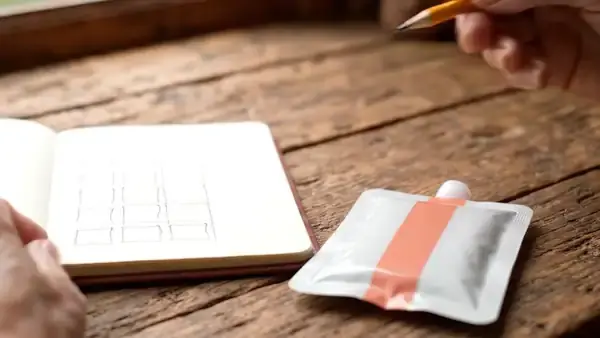
Focus & Recall is a single-serving gel from HealthyCell, a company in Mount Pleasant, South Carolina.
Each pouch holds 25 milliliters, a little under one fluid ounce.
You tear it at the notch and squeeze the gel into your mouth, or into a glass of something else.
The seller's own phrase for it is "Mix it, squeeze it, blend it."
The gel is pale orange, somewhere between a thick juice and a loose jelly, and the flavor printed on the pouch is peach and pineapple.
A box holds thirty pouches, and the serving is one pouch.
Each pouch carries 30 calories and 2 grams of added sugar, from apple juice concentrate.
There is nothing to swallow whole and no measuring spoon.
There is also no need for a glass, which matters more than it sounds when your second morning happens in a truck, a waiting room or a workshop.
The panel lists thirteen lines.
Three B vitamins, taurine, tyrosine, a ginseng extract, phosphatidylserine, theanine, a plant-seed oil called Ahiflower, turmeric curcuminoids, caffeine and huperzine A.
You have just read every one of those lines, sorted by the clock their studies ran on.
Hold on to only one of them as you look at the pouch: the caffeine, the one line nearly everybody already knows the feel of.
If you want to understand how this pouch will feel at two in the afternoon, start with the caffeine.
Everything else on the panel is quieter, slower or less certain, and the reviews bear that out.
The Late Pouch, and the Five Who Moved Theirs
If the afternoon is the pouch's best hour, the evening is its worst.
The reviews say so more plainly than I could.
Five buyers wrote that a pouch taken later in the day interfered with their night.
Three of them moved it to the morning and reported no further trouble.
One wrote that she tries not to take it past early to mid-afternoon, after a couple of bad nights, and that she only takes it a few times a week.
Another, a student, wrote that it has to be taken in the morning, because taking it later made it hard for her to get to bed.
And one wrote the review that I think every reader should see before buying, because it explains why he takes it less than he would like.

I dont use it as much as i'd like. I fear that the cafeeine will keep me from sleeping ati night, or else i'd take it at night.
Forty milligrams is not much caffeine.
But the FDA lists a disturbed night among the effects of too much, and "too much" is personal. [1]
Some men can drink an espresso after dinner and go straight to bed.
Others learned long ago that a cup after two o'clock means lying awake at midnight.
If you are the second kind, your afternoon window is narrower than the seller's clock suggests.
A pouch at one o'clock may be fine, and a pouch at four may not.
There is a simple way to find out, which costs you one evening.
Take the first pouch of the box right after lunch, and note how your night goes.
If that night is ordinary, you have your window.
If it is not, move the pouch earlier, the way three of those five buyers did.
The latest hour for a pouch is not on the label. You find it on your own first night.

A Pouch Bought Before 2022 Was a Different Pouch
Reading every review in date order showed me something the seller's page does not mention.
The recipe changed.
The earliest reviews date from the summer of 2020.
One from that summer describes the pouch as carrying about 100 milligrams of caffeine.
Then, in March 2022, a longtime buyer wrote this.

Hi this is my favorite product by healthy cell. I loved the energy it gave me but that's not the case now that th caffeine level in this product has went from 100mg to 40mg. Please bring it back up or at least to 70 or 80 mg?!
That is a single buyer's account, not a document from the company.
But it matches the older review, and it matches the current label, which says 40.
It also explains why the seller's sentence about "a cup of coffee" sits so oddly beside the panel.
A hundred milligrams is close to a small cup, and forty is not.
Here is why this matters for you.
Of the 602 reviews, 123 were written before March 2022, about a pouch with considerably more caffeine.
A handful of those older reviews also mention ingredients that are not on the current panel.
So when you read the seller's review page, check the date before you trust the praise.
I did that myself.
Every review I quote on this page was written after March 2022, about the pouch you would receive today.
The recent reviews average 4.57 stars, almost exactly the same as the whole set. The recipe changed; the ratings did not.

What the Label Leaves to You
The seller is specific about onset and duration.
It is much less specific about everything around them, and those gaps are yours to fill.
The listing does not print a latest hour.
It does not say whether to take the pouch with food or on an empty stomach, and it does not say what to do if one pouch feels like too little.
Those three silences matter more for an afternoon product than for a morning one.
In the morning, a late hour is not a risk, breakfast is usually on the table, and nobody reaches for a second pouch before nine.
In the afternoon, all three questions arrive at once.
Is three o'clock too late, does it go before or after the sandwich, and should a slow day get two?
Here is how I would answer them from what is actually known.
The latest hour is the one your first night tells you, as the late-pouch section explains.
Food is a matter of comfort, since nothing on the seller's page ties the pouch to a meal.
Most of the afternoon buyers took it just after lunch, and none of them wrote that it upset their stomach.
One of them, who gave it three stars, described the whole effect as the absence of something rather than the arrival of something.

I have been taking the focus and recall in the afternoon at work. I have not noticed any obvious difference with taking it, but I definitely do not experience the post lunch energy crash that I used to.
A second pouch is where I would be most careful.
Two pouches would still be only 80 milligrams of caffeine, well under the 400 milligrams a day the FDA cites for most healthy adults. [1]
But two pouches would also mean double the huperzine A, double the turmeric and double the sugar, and the seller's serving is one.
If one pouch feels like too little, the honest reading is that the pouch is not the right tool for that afternoon, not that you need two.
One pouch is the serving. The seller never says two, and neither will I.
The Taste, Which Is What Most Reviews Are Really About
I promised to come back to the taste, and here is why it earns a whole section.
More than one review in six talks about the flavor, which makes it the most discussed subject on the seller's page.
Most of those reviews are kind about it.
Buyers call it peachy, pleasant, tolerable, easy to get down.
One four-star buyer folded the taste and the hour into the same short line.

This is a good tasting supplement. I take it mid afternoon and it helps ward off the droopy, lazy feelings I sometimes have.
A good number are not kind at all.
Some call it bitter, some say it is a kick in the taste buds, and a few say plainly that they could not finish a box.
The most honest of those came from a buyer who gave it one star without ever judging the contents, because she never got that far.

I was very much looking forward to taking this product regularly, but the flavor just does not agree with me… So I haven't taken it at all. I'm wondering if there's another flavor that I might be able to swallow? I don't do shakes or smoothies or anything, so I tried diluting it in water and club soda, but still can't swallow it.
Taste sounds like a small matter next to caffeine and studies.
It is not, because a box you cannot finish is a box that does nothing, however good its panel.
The buyers who get past the flavor describe a handful of workarounds.
They stir it into fruit juice, apple cider, a morning shake or a glass of water with a flavoring, and one freezes the pouches and squeezes them like an ice pop.
I cannot taste it for you, and I will not pretend that a reviewer's tongue is mine.
What the reviews agree on is narrower: it is sweet, it is thick, and it tastes of peach, which some people love and some cannot stand.
If you already know you dislike peach, or dislike a thick texture, find that out with one pouch before you plan a month around them.
The seller's thirty-day window allows for it, and I explain the conditions further down.

Three Afternoons a Week, or Every Day
The seller says you can take a pouch every day and that the product is designed for long-term use.
Several of the most thoughtful buyers do not.
One wrote that she takes it a few times a week, when she is at work or traveling and feels she needs a little support.
Another wrote that she takes it a few times a week and never past mid-afternoon.
That rhythm matches the hour lines, and it changes the arithmetic of a box completely.
It is worth doing the sums before you order, because the sums decide what the thirty-day window is actually worth.
The box at the seller's rhythm
Thirty pouches, one a day, is thirty days.
The box runs out on almost exactly the day the seller's return window closes.
That window, by the seller's own policy, is thirty days from the order, not from the day the box arrives.
So a box that spends five days in transit gives you about twenty-five days of pouches before the window shuts.
The box at the reviewers' rhythm
Three afternoons a week, thirty pouches last about ten weeks.
By the end of the return window, you will have used about a dozen.
A dozen afternoons is a fair sample for judging an hour line.
It is a poor sample for judging a month line, and the month lines are where the daily rhythm spends most of its money.
There is no right answer here, only a choice you should make on purpose.
If you want the afternoon window, three or four afternoons a week is what the careful reviewers do.
If you want to give the month lines their chance, you would need to take it daily for far longer than one box, and the studies behind those lines give you little reason to expect much at these amounts.
I would rather tell you that now than after your third box.
A Week of Second Mornings, Planned on Paper
Most of us do not have seven identical afternoons.
We have a Monday with the mail and the bills, a Wednesday with a long drive, a Friday with cards at the club, and a Sunday that asks nothing of anybody.
That is exactly why the pouch makes more sense on some afternoons than on others.
Here is how I would lay out a week, and you can swap in your own.
- Monday, after lunch: the bills and the paperwork, the kind of close reading that punishes a wandering eye. A pouch day.
- Tuesday: an easy afternoon in the yard. No pouch; a glass of water and a walk will do.
- Wednesday, after lunch: the ninety-minute drive to see the grandchildren. A pouch day, taken before you leave the kitchen, never at the wheel.
- Thursday: a quiet afternoon with a book. No pouch.
- Friday, after lunch: the card game, where you want to keep track of what has been played. A pouch day, if your first night went well.
- Saturday and Sunday: no pouch. Nothing on those afternoons needs one.
That is three pouches a week, which is what the careful reviewers describe.
It is also the rhythm that makes one box last about ten weeks rather than one month.
The point of planning it on paper is not the plan itself.
It is that you decide in advance which afternoons are worth a pouch, instead of reaching for one out of habit.
A habit is how a product sold by the hour quietly becomes a product bought by the month.
A plan is how it stays a tool.

The Buyers Who Wrote Down Their Age
Most reviewers never say how old they are.
A few do, and those are the ones I read twice, because they are the closest thing on the seller's page to readers of this paper.
They do not agree with one another, and that is exactly why they are useful.
Here are four of them, all written after the recipe changed, printed in full.

i am 77 yrs. old and in fairly well health. my mental state is well. there are times when my mental focus seems hard for me to comprehend readings or talks. so i see your products on line and ordered the FOCUS +RECALL,30 days in and i don't feel any benefits.i will not be reordering

I am familiar with ingredients in Focus product and like that it's a liquid form. I've used it for almost a month and am aware that my focus and recall is better. That's pretty good for being 68. I will continue using the supplement for sure.

So easy to take. Seems to be helping with better focus. (From a 67-Year-Old) I would recommend this product.

I wish I could say more of the products, I haven't taken the focus*recall as consistently as I would like, I had about a two week period where I was taking a packet daily and was impressed with the results as far as recall and planning, I have a hectic schedule at 63 yrs of age and take my supplements before heading to work, and at times I don't have time to take the liquid packet.
Four men and women in their sixties and seventies, and four different verdicts.
One felt nothing in thirty days and said so, two felt it helped, and one could not keep the habit going long enough to be sure.
I put Larry's review first on purpose.
A seventy-seven-year-old who bought a box, gave it a fair month and wrote down that he felt nothing is worth more to you than a dozen five-star ratings from people who never mention their age.
These are opinions, not measurements, and none of these four had a placebo to compare against.
They tell you what a month of pouches felt like to four people, and they tell you that "nothing" is one of the possible answers.
Four buyers our age, four verdicts. That is what an honest set of reviews looks like.

The Thirty-One Low Ratings, Read the Same Way
I read the one-star and two-star reviews with the same notebook open.
Since the recipe changed in 2022, there are thirty-one of them.
About half say, in one way or another, that the buyer noticed no difference.
About a third are about the taste, and several say both.
The rest are single complaints.
One buyer said the turmeric did not sit well with her stomach, one reported a headache, one objected to the plastic packets, one disliked the stevia, and one never received the parcel.
Only one of the thirty-one names an hour, and it is a man who flies freight at night and says it keeps him alert.
He gave it two stars anyway, because of the taste.
That silence about time is telling.
The buyers who were disappointed mostly took the pouch without choosing an hour, and judged it as a daily product that should have changed something over a month.
Judged that way, the pouch often disappoints, and the month-line evidence says it probably should.
The most striking of these reviews was written on the twenty-eighth day of a box.

This is day 28. I have not noticed any real difference. I am hoping that during this coming week, things will kick in. But it doesn't look promising :(
Day twenty-eight is two days before the seller's thirty-day window closes, counting from the order.
If you ever find yourself writing that sentence, stop waiting for the coming week and call the seller instead.
I do not read the low ratings as proof that the pouch fails.
I read them as proof that a product sold by the hour disappoints people who expect it to work by the month.
The Cheapest Hour Comes Out of the Tap
Before any pouch, there is a glass of water, and I would be doing you a disservice if I skipped it.
The afternoon slump that so many reviewers describe has more than one cause, and some of them cost nothing to address.
In a study that followed 1,111 adults aged 60 to 89 in Berlin, about a third were measurably short of water. [16]
Those who were showed a steeper drop over time in a test of processing speed, the kind of quick thinking the afternoon asks for.
That was an observational study, which means it found a link rather than proving a cause.
A 2021 review of studies in adults over sixty found some, though sparse, evidence connecting low water intake with poorer performance on thinking tests. [17]
I do not offer that as a replacement for anything.
I offer it because a glass of water with lunch is the one habit on this page that has no taste problem, no caffeine and no return window.
If your second morning drags, try the glass first for a week, then decide whether a pouch has anything left to add.
You may find the answer is yes, and you will know exactly what the pouch is adding.

The Lines to Show Your Pharmacist
Three lines on this panel are worth a short conversation at the pharmacy counter before your first pouch.
None of them is alarming, and all of them are the kind of thing a pharmacist answers in two minutes.
The first is huperzine A.
It is a plant compound that acts on an enzyme the body uses to switch nerve signals off, and that is why it belongs in front of a pharmacist if you take anything daily at all. [8]
The second is the caffeine.
The FDA notes that some people are more sensitive to caffeine than others and advises talking with a health care provider if you take medicines. [1]
The third is the turmeric.
The federal government's complementary-health center records harm to the organ that processes what you swallow in some people who used highly absorbable curcumin products. [15]
The pouch's 100 milligrams of curcuminoids is a modest amount, and the label does not describe it as a high-absorption form.
But if you take anything daily, or you have ever been told to watch that organ, the pharmacist is the person to ask.
Take the box itself to the counter. The panel on the back is what the pharmacist needs to see.
If You Buy a Box: One Hour, Ten Afternoons, One Notebook
If what you have read so far still interests you, here is how I would use a first box.
It is built around the clock, because the clock is where this pouch makes sense.
- Pick one hour, and make it the hour after lunch unless your mornings are harder.
- Take the first pouch on a quiet day, right after lunch, and note how your night goes.
- Use it three or four afternoons a week, on the afternoons that actually ask something of you.
- Keep one line per pouch in a small notebook: the hour, the task, and whether the afternoon felt any different.
- Keep the rest of the afternoon the same, including your usual coffee, so you are judging the pouch and not a change in routine.
- Mark the thirtieth day after your order on a calendar, because that is when the seller's window closes.
After ten afternoons, read your notebook.
If most lines say the same as a glass of water would have, you have your answer, and you still have time to act on it.
If the lines say something different, you also have your answer.
And you will know which hour to spend the rest of the box on, which is more than most reviews can tell you.
Ten afternoons, one notebook, one honest answer.
Who It Suits, and Who Should Pass
Having read the panel, the policies and every review, here is my honest sorting.
- It suits a man whose hardest stretch is the hour after lunch and who wants a small, measured caffeine lift without a mug in his hand.
- It suits a man who cannot or will not carry a glass of water, because the pouch needs none.
- It suits a man who can use it on chosen afternoons rather than every day, and who will keep a simple note of how it goes.
- It does not suit anyone hoping the month lines will do something at these amounts, because the studies above give little reason to expect it.
- It does not suit anyone who already drinks plenty of coffee and wants more of the same effect, because 40 milligrams will barely register.
- It does not suit anyone who dislikes peach or thick textures and will not stir it into a drink.
- It does not suit anyone who takes anything daily and has not first shown the panel to a pharmacist.
- It does not suit anyone for whom a worry about memory has lasted months, because that worry belongs with a clinician, not with a pouch.
Mount Pleasant, South Carolina, and a Telephone That Answers
The pouch is sold by Life Science Institute LLC, which trades as HealthyCell.
Its contact page gives a street address in Mount Pleasant, South Carolina, a toll-free telephone number and an email address.
That is more than some sellers publish, and it matters if an order goes wrong.
You can reach them on (800) 975-9606 or at support@healthycell.com.
Standard shipping inside the United States is at no charge on subscriptions and on one-time orders above the seller's order minimum.
A single box ordered once is below that minimum, so expect a shipping charge at checkout.
The seller's return promise gives you thirty days from the order to ask for a refund.
You send the product back with your order number, you pay the return postage, and the seller says the refund follows within one to seven business days after it arrives.
The price is on the seller's page, and I do not print it here, because prices change and this page does not.
The seller also offers larger boxes and a subscription, and you can see all of them before you decide anything.
Thirty pouches, and the afternoons you choose for them
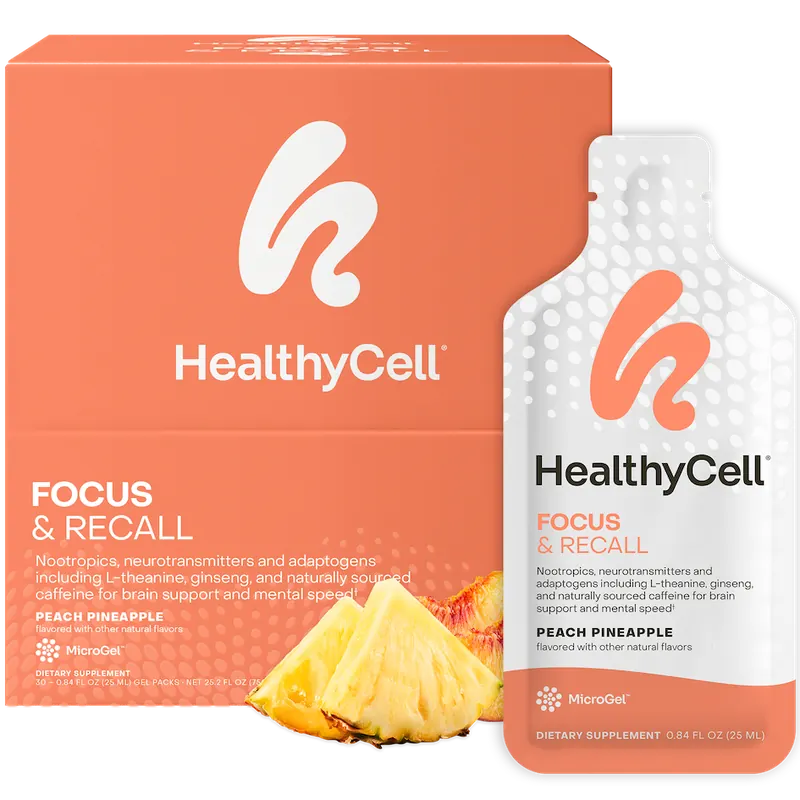
A 25-milliliter gel pack you squeeze into your mouth or a glass, with thirteen ingredients, 40 milligrams of caffeine and a peach-pineapple taste.
SEE THE POUCHES AT HEALTHYCELLSold and shipped by HealthyCell (Life Science Institute LLC), Mount Pleasant, South Carolina · Shipping at no charge above the seller's order minimum or on a subscription · Thirty days from the order to ask for a refund, product returned at your cost
Twelve Questions, Answered in a Line or Two
Short answers on the pouch and the clock
Is this a medicine?
No. It is a dietary supplement, and it is not meant for any medical condition.
How much caffeine is in one pouch?
Forty milligrams. A 12-ounce cup of brewed coffee holds 113 to 247. [1]
When do buyers take it?
The few who say are split almost evenly between the morning and the hour after lunch.
How late is too late?
That depends on you. Five buyers found a late pouch cost them their evening, and three moved it to the morning.
Do I need water?
No. You can squeeze it straight from the pouch or stir it into a drink.
How long does the seller say it lasts?
The seller says you should feel it within thirty minutes and that it lasts two or three hours.
Can I take it every day?
The seller says yes. The evidence for the ingredients that only work over months is weak at these amounts.
How long does a box last?
Thirty days at one a day, or about ten weeks at three afternoons a week.
Are the older reviews about the same product?
Not quite. Reviews from before March 2022 describe a pouch with more caffeine.
Is there sugar in it?
Two grams of added sugar and 30 calories per pouch, from apple juice concentrate.
What if it does nothing for me?
You have thirty days from the order to ask for a refund. You return the product at your own postage.
How do I reach the seller?
By telephone on (800) 975-9606 or by email at support@healthycell.com.
The Afternoon, Counted on One Card
- Focus & Recall is a 25-milliliter gel pouch from HealthyCell, taken straight or stirred into a drink, with no water needed.
- The seller's own page says it starts within thirty minutes and lasts two or three hours.
- Its caffeine is 40 milligrams, which is a third or less of a 12-ounce cup of brewed coffee. [1]
- Five lines on the panel were tested in the hours after a single dose, and caffeine with theanine has the closest match to a study. [3]
- Seven lines rest on daily use over weeks or longer, and none shows a clear benefit at the pouch's amounts. [9] [10] [14]
- Of 602 reviews, fewer than one in ten name an hour, and those split between breakfast and the hour after lunch.
- Five buyers wrote that a late pouch cost them their evening.
- Reviews from before March 2022 describe a pouch with more caffeine.
- A box lasts thirty days daily or about ten weeks at three afternoons a week, and the refund window is thirty days from the order.
- Huperzine A, the caffeine and the turmeric are worth showing to a pharmacist first.
- A glass of water with lunch costs nothing and is worth trying first. [16]
What Two or Three Hours Are Worth
I started this page with a question about the clock, and I will end with the answer the clock gave me.
This pouch is honest about one thing that most products blur: it is sold by the hour.
Its seller says so, its best-supported line works that way, and its most careful buyers use it that way.
Where it is less honest is in the long view.
The label reads like a daily, long-term product, and most of the lines that would need months to matter are either unsupported or present at a fraction of their studied amounts.
So I would not buy it as a daily habit for the months ahead.
I would consider it as a small, measured afternoon tool, used on the afternoons that ask something of you, and judged by what those afternoons feel like.
That is a modest recommendation, and I think it is the right size.
Two or three hours of a slightly sharper afternoon, a few times a week, is a reasonable thing to want, and a reasonable thing to test for yourself.
If you do, choose your hour on purpose.
For most of the buyers who bothered to write it down, that hour comes right after lunch, at the start of the second morning.
One box, a notebook, and ten chosen afternoons
A 25-milliliter gel pack you squeeze into your mouth or a glass, with thirteen ingredients, 40 milligrams of caffeine and a peach-pineapple taste.
SEE THE POUCHES AT HEALTHYCELLHealthyCell (Life Science Institute LLC) · 3301 Salterbeck Street, Ste 102, Mount Pleasant, SC 29466 · (800) 975-9606 · support@healthycell.com · Thirty days from the order to ask for a refund
P.S. If you keep one number from this page, keep forty.
It is the caffeine in one pouch, and it is the clearest way to judge what the pouch will feel like at two o'clock.
P.P.S. If a worry about your memory has been with you for months, see your own clinician before you buy anything at all.
No pouch, drink or bottle was ever going to answer a question that a proper appointment can.
The full panel of this pouch, line by line, with each amount, what each ingredient is, what its research found and the cautions that go with it, is written out in the ingredient guide linked at the foot of this page.
That guide also lists every reference in full and carries the disclosures this page is required to make.